
In wafer wet cleaning, two technology routes have long coexisted: batch (tank) cleaning that processes a whole cassette of wafers together, and single-wafer cleaning that treats one wafer at a time. As advanced nodes progress, the balance has clearly tilted toward the single-wafer route. This is not a rejection of batch cleaning, but a fundamental change in what different process nodes demand in terms of cleanliness, cross-contamination control and chemical consumption. Understanding the strengths and limits of these two routes is the key to grasping how domestic cleaning equipment is being positioned.
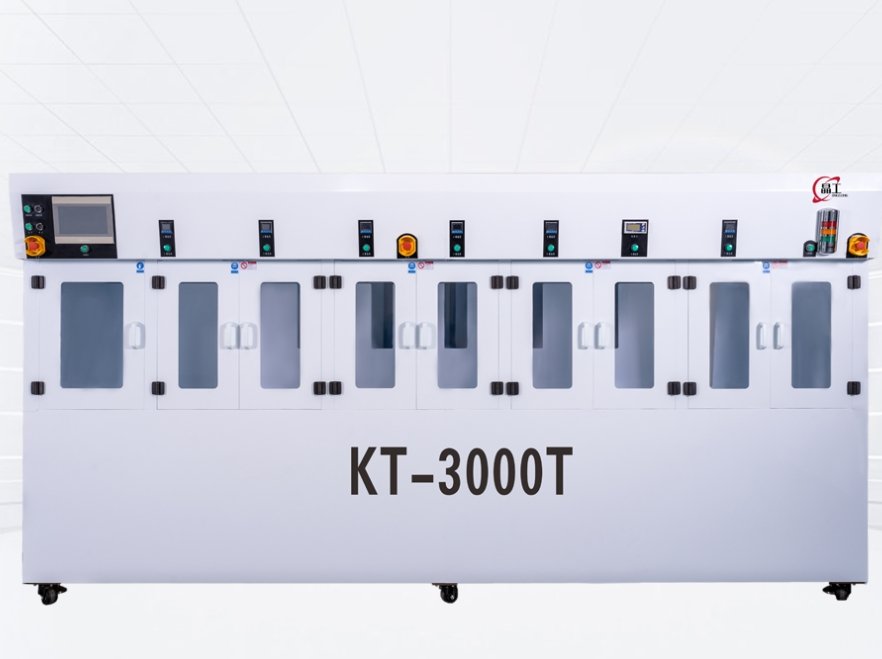
Strengths and boundaries of batch cleaning
Batch cleaning immerses a batch of wafers in the same tank of chemistry or ultra-pure water, assisted by heating, ultrasound, rinsing and drying. Its advantages are high throughput, low cost per wafer and efficient batch use of chemicals, so it remains widely used at mature nodes, in silicon wafer manufacturing, compound semiconductors and cost-sensitive scenarios. But its inherent limits are cross-contamination risk between wafers in the same bath, chemical concentration decay as more wafers are processed, and difficulty applying individualized control to each wafer. These limits are acceptable at mature nodes but become a yield bottleneck at advanced nodes, where even trace cross-wafer contamination can ripple across the batch.
Why single-wafer became the leading-edge default
Single-wafer cleaning holds one wafer on a rotating chuck and precisely delivers chemistry, ultra-pure water and megasonic through nozzles, finishing with spin-drying. Its core advantages are independent per-wafer processing with zero cross-contamination, precise on-demand chemical dosing that cuts consumption dramatically, and recipes tailored to each wafer's patterns, making it easy to integrate megasonic, chemical spray and other methods. As line widths shrink, patterns densify and wafer value soars, the yield cost of cross-wafer contamination and chemical non-uniformity far outweighs the higher capital cost of single-wafer tools. This is the fundamental reason leading-edge fabs have pivoted fully to the single-wafer approach. The economics flip as the cost of a defective wafer rises, making single-wafer's lower chemical use and higher yield a net saving despite the higher price tag.
The two routes are not simple substitutes
It must be emphasized that single-wafer and batch are not mutually exclusive. At mature nodes, front-end bulk stripping and post-polish silicon wafer cleaning, batch tools still offer cost-effectiveness; while at advanced logic, memory and key post-CMP cleaning steps, single-wafer is the standard. Production lines often run both, dividing the work. From an economic standpoint, single-wafer tools carry high capital cost but use little chemistry, are highly automated and lose little yield, so their total cost is better in high-value advanced processes; batch tools, with their batch throughput, still hold a clear cost edge in large-area, low-complexity mature steps. They are complementary choices aimed at different nodes and different steps rather than pure substitutes.
How fabs plan the optimal mix
For a fab, sensible line planning is to flexibly configure both methods according to step characteristics on the same line: critical high-precision cleaning uses single-wafer, while non-critical large-area stripping or rinsing uses batch, achieving the optimal balance of yield and throughput. This hybrid strategy is increasingly common in modern fabs, and it means equipment vendors must be fluent in both architectures rather than betting everything on one. Domestic makers pursuing both routes can defend mature-node cash flow while investing in advanced-node growth, which de-risks their product roadmap. For procurement teams, this also means evaluating vendors on their ability to provide a coherent mix rather than a single champion tool.
How domestic vendors are positioning across both routes
Facing the single-wafer and batch routes, most domestic equipment vendors pursue a 'two-pronged' strategy: defending mature-node and silicon wafer markets with batch cleaning tools for stable cash flow, while concentrating resources on breaking through single-wafer cleaning and its drying matching to capture advanced-node growth. This layout both builds a near-term revenue base and positions the company for long-term technology evolution. In niche fields such as compound semiconductors and power devices, Chinese vendors typically start from semi-automatic single-wafer tools, using flexible customization to respond quickly to customer needs, then gradually move toward full automation and higher precision. This staged entry lowers qualification risk and matches the way domestic fabs prefer to de-risk new suppliers.
From a yield-per-dollar perspective, the choice between batch and single-wafer is ultimately an economic calculation. Batch tools spread capital across many wafers at once, which is attractive when wafer value is moderate and throughput dominates the cost equation. Single-wafer tools spend more per wafer but protect yield on high-value product, which becomes compelling once the cost of a scrapped wafer exceeds the tool's amortization. As advanced-node wafers carry enormous value, fabs increasingly accept single-wafer's higher price to avoid even a small scrap rate. This economic logic is what locks single-wafer in at the leading edge while keeping batch tools alive in mature and cost-sensitive segments.
Whichever route is chosen, post-clean drying remains the key to yield. Hebei Zhongke Microelectronics Co., Ltd. offers a fully automatic single-wafer cleaning machine, an InP cleaning machine (semi-automatic single-wafer, SQX-150-5Y1D) and single-wafer cleaning & spin dryers, providing flexible single-wafer cleaning and drying support for compound semiconductors and different process nodes, balancing cost and cleanliness according to customer needs.
In summary, the single-wafer versus batch debate is not about which technology is universally better, but about matching the tool to the step. Leading-edge fabs will keep shifting to single-wafer where yield justifies it, while batch cleaning remains economically vital in mature and cost-sensitive production. The winners in the equipment market will be those that offer both routes and help customers optimize the mix.
The cost comparison deserves nuance. Batch tools win on cost per wafer for large volumes at mature nodes, while single-wafer tools justify their higher price by eliminating cross-contamination and cutting chemical consumption through precise dosing. Many fabs optimize by running bulk cleaning in tanks and reserving single-wafer stations for the few critical steps where particles matter most. This hybrid strategy means equipment makers must offer both architectures, and domestic vendors that can supply either option are better positioned to fill a modern fab's whole wet-process floor.
From batch to single-wafer, the divide between cleaning routes reflects the relentless pursuit of 'cleanliness and control' as processes advance. For selection advice on cleaning routes and spin-dry matching, call the consultation hotline: 17177768881.