
As cleaning objects move from micron-scale features toward nanoscale structures, traditional megasonic cleaning faces a new challenge: it must shake ultra-fine particles off patterned structures without damaging the fragile lines. Megasonic cleaning has thus moved toward high precision, and application of the 950 kHz to 3 MHz frequency band has become the key to balancing 'removal power' with 'damage-free performance'. It is also a benchmark for judging a cleaning equipment vendor's technical level, because the frequency choice reveals how well the vendor understands the physics of the process.
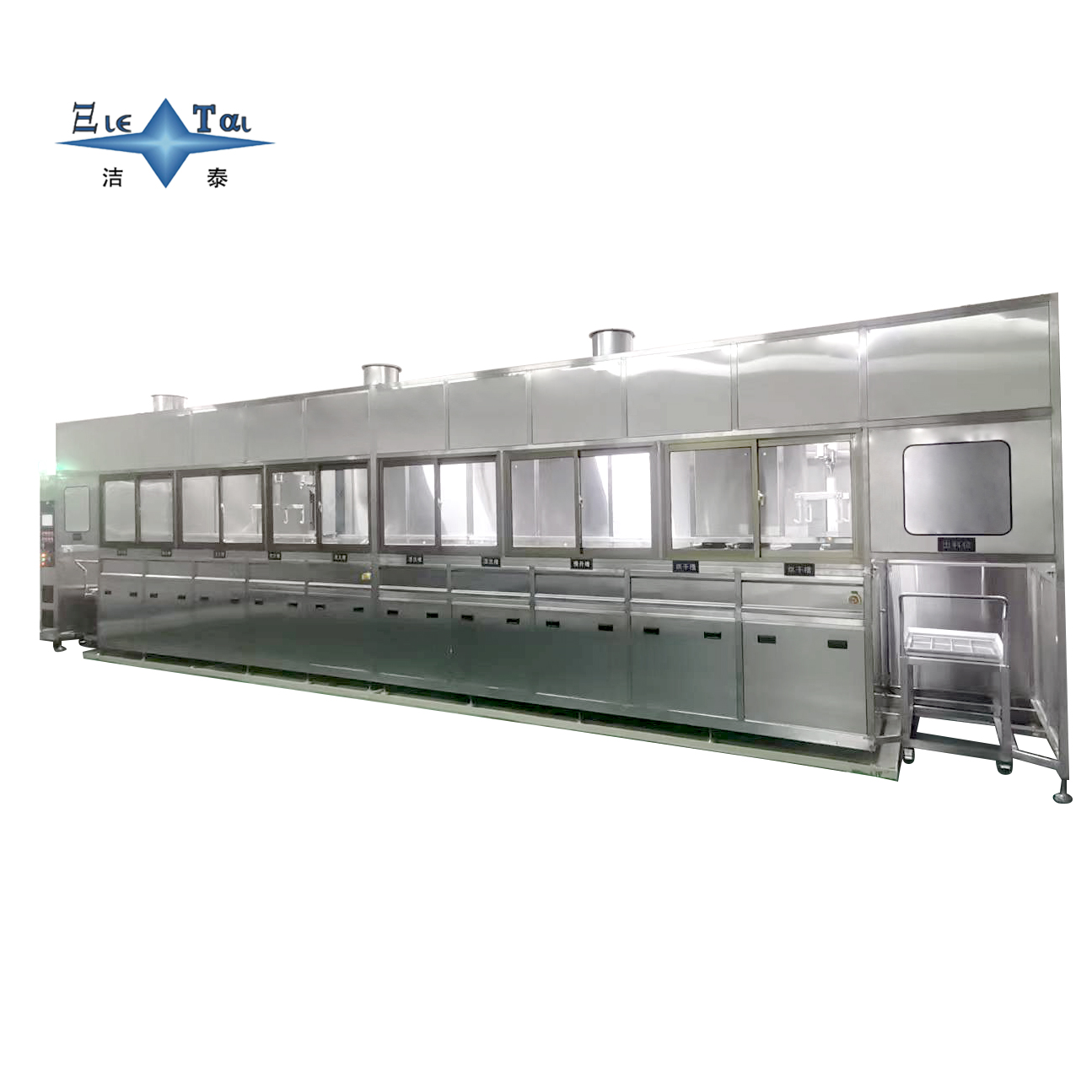
How megasonic cleaning works
Megasonic cleaning uses a transducer to generate high-frequency sound waves in the cleaning liquid, creating a stable flow field and micro-cavitation effects that drive liquid shear across the wafer surface, stripping nanoparticles from it. Compared with low-frequency ultrasound, megasonic cavitation bubbles are smaller and the energy is gentler, so it removes particles while significantly reducing structural damage. This property has gradually made it the primary physical cleaning method in advanced manufacturing, replacing low-frequency ultrasonics where pattern damage would otherwise dominate the defect budget. The gentleness comes at a price, however: megasonic tools require tighter control of temperature, chemistry and flow to remain effective.
The trade-off in choosing a frequency band
Frequency is the most core process parameter in megasonic cleaning. Higher frequency means shorter wavelength, finer cavitation, and is better for cleaning dense, fragile advanced patterns, but its ability to remove large particles is relatively weaker. Lower frequency gives stronger removal but may cause pattern damage. In practice, around 950 kHz is the common 'balanced band', while moving toward 1 MHz, 2 MHz and even 3 MHz high-frequency megasonic is increasingly used for damage-free cleaning of high-aspect-ratio, easily damaged structures. Depending on particle size and pattern density, equipment often needs to switch flexibly across multiple bands rather than committing to a single fixed frequency.
Differentiated technology routes
To further reduce damage, the industry has developed differentiated routes such as space-accelerated megasonic (SAPS) and extreme damage control (TEBO), controlling sound-field distribution and cavitation intensity to achieve the best balance between particle removal rate and pattern damage rate. These technologies are often integrated with chemical spraying and single-wafer spinning to form a complete single-wafer high-precision cleaning solution. One could say that the megasonic band and sound-field control capability have become the technical high ground in single-wafer cleaning equipment competition. Vendors that can tune the cavitation regime to the specific layer being cleaned gain a clear advantage, while generic off-the-shelf megasonic tanks struggle to meet advanced-node requirements.
Megasonic in the integrated cleaning loop
In modern single-wafer cleaning tools, megasonic is rarely used alone; it works in synergy with chemical spray, PVA brush and two-fluid jetting. A typical cleaning flow uses chemistry first to dissolve contaminants, then megasonic or two-fluid to strip particles, and finally ultra-pure water rinse with spin-drying. The megasonic frequency, chemical concentration, temperature and mechanical intensity must be jointly optimized for the specific contamination type and pattern structure. This multi-method integrated cleaning capability is exactly what distinguishes single-wafer tools from traditional batch cleaning, and it is the process know-how that domestic equipment vendors must keep accumulating. As features shrink, tuning this integrated loop well matters more than any single headline specification.
Suppliers and the damage-control data race
Megasonic cleaning is as much a data race as a technology race. Different pattern types, film stacks and contamination levels each demand their own frequency and recipe window, and the vendor with the richest process database can converge on a good result faster. Leading suppliers invest heavily in metrology to correlate megasonic settings with particle counts and pattern damage on customer wafers, turning each qualification into reusable knowledge. For domestic vendors, closing this data gap is the main barrier to advanced-node entry; until they can demonstrate equivalent damage-control metrics on customer wafers, they will be confined to less critical steps. The good news is that every post-CMP, backside or compound-semi cleaning order adds data, gradually building the library needed for higher-end work. This cumulative dynamic is why early foothold orders are strategically valuable beyond their immediate revenue.
Beyond silicon logic, megasonic cleaning is also gaining ground in compound semiconductors such as silicon carbide and indium phosphide, where substrate and device surfaces are often harder and more contamination-sensitive. These materials tolerate different cavitation regimes, which gives vendors with multi-band megasonic capability an advantage when serving both silicon and compound-semi customers. As the power-device and optoelectronics markets expand, demand for tunable, damage-free megasonic cleaning is rising in lockstep. For domestic equipment makers, this diversification reduces dependence on a single customer segment and opens additional reference opportunities.
For high-precision cleaning coupled with downstream drying, Hebei Zhongke Microelectronics Co., Ltd. offers a fully automatic single-wafer cleaning machine, a two-fluid wafer cleaning machine and single-wafer cleaning & spin dryers. These can combine megasonic, two-fluid and other cleaning methods with centrifugal spin-drying, providing a whole-line wet-process package from cleaning to drying and adapting to different materials and pattern structures, with recipes tuned jointly with customers to balance particle removal against pattern damage.
In summary, megasonic cleaning has become indispensable wherever nanoscale particles must be removed without damaging delicate structures. The continuous refinement of frequency bands and sound-field control reflects the semiconductor industry's relentless pursuit of a cleaner, more damage-free process. Vendors that can couple megasonic know-how with reliable drying will remain competitive as features shrink further and new materials enter production.
Equipment reliability is another quiet battleground. Megasonic transducers degrade over time, and a slowly losing transducer can quietly weaken removal without obvious alarm triggers, which is why fabs monitor output power and defect trends together. Modern tools add feedback loops that compensate for aging and flag drift early. Vendors that provide transparent transducer health data and fast replacement services win multi-year service contracts. Together with integrated spin-drying, this reliability focus turns megasonic cleaning into a sustainable long-term partner rather than a one-time purchase.
As process nodes continue to shrink, investment in tunable megasonic and integrated drying will remain a priority for fabs worldwide, and vendors with rich recipe databases will keep the upper hand, where small differences in cavitation control translate directly into measurable yield gains. To configure high-precision cleaning and spin-dry equipment, with full local recipe support, call the consultation hotline: 17177768881.