
Wafer cleaning equipment may be the headline, but what truly sets the upper limit of cleaning performance is often the invisible 'water and chemical' system behind it. Ultra-pure water (UPW) and wet electronic chemicals are the 'water hard requirement' behind wafer cleaning; without stable, high-purity water and chemistry supply, even the most advanced cleaning machine cannot perform. Understanding this supporting logic is key to grasping the full cost structure of a wafer fab, because water and chemicals are recurring consumables, not one-time capital.
Why ultra-pure water is a hard requirement
The wafer rinse stage uses ultra-pure water for almost the entire process. UPW has extremely stringent limits on resistivity, particles, metal ions, total organic carbon, dissolved oxygen and micro-particles, and its quality directly determines the cleanliness of the wafer after rinsing. A large fab's UPW system can produce hundreds to over a thousand tons of high-purity water per hour, piped in a loop to every process tool; any water-quality fluctuation can affect whole batches of wafers. Water stability therefore equals process stability, and fabs treat UPW monitoring as a continuous real-time task rather than a periodic test.
Wet electronic chemicals as a matching system
Beyond water, cleaning relies on wet electronic chemicals such as sulfuric acid, hydrogen peroxide, ammonia, hydrofluoric acid, hydrochloric acid and proprietary cleaning formulations. The purity grade (such as process grade or MOS grade) and mixing ratio of these chemicals directly affect contaminant removal and the degree of corrosion on the wafer surface. Precision chemical delivery, in-line mixing and recovery are key links in the coordination between cleaning equipment and the facility system. Different cleaning flows, such as standard RCA cleaning or megasonic cleaning, impose very different requirements on chemical types and concentrations, which is why flexible chemical delivery is essential.
The coordination of water, chemicals and equipment
In a real line, the cleaner must tightly coordinate with UPW supply, chemical delivery and waste treatment: whether incoming water meets spec, whether chemical mixing is stable, and whether waste liquid can be treated compliantly, all constrain the stability of the cleaning process. A reliable cleaning tool must not only perform well itself but also be easy to interface with the facility's water, gas, chemical and waste systems. The maturity of this equipment-to-facility interface often determines both build speed and long-term operating cost, since a tool that requires extensive field modification can delay ramp-up for months.
Water quality indicators and process impact
In terms of water-quality indicators, UPW resistivity must approach the theoretical limit, while micro-particles, metal ions, organics and dissolved gases are all tightly controlled. In actual cleaning, UPW is used not only for final rinsing but also for in-line dilution and formulation of chemistry, so water-quality fluctuations are amplified step by step and ultimately reflected in wafer surface cleanliness. On the chemicals side, the progress of domestic high-end wet electronic chemicals supports cleaning equipment localization, and the relationship is mutually reinforcing: stable water and chemical supply is the prerequisite for a domestic cleaner to deliver its best performance. This is why fabs qualify chemical suppliers alongside equipment vendors, rather than treating consumables as a separate procurement category.
Water systems expand in step with capacity
During fab expansion, UPW and wet chemical systems are often the 'leading force' that must be built before process tools arrive. Their design and construction schedule directly affect the ramp-up of the whole plant. For example, from raw-water pretreatment, reverse osmosis and ion exchange to terminal polishing, each stage must be matched precisely to fab capacity; specialty gas piping requires extreme tightness and purity, and any leak can affect whole-line yield. When selecting process equipment, new lines must plan facility systems in parallel; domestic vendors that offer mature equipment-to-facility interfaces greatly reduce customer integration and commissioning cost.
The UPW treatment chain in detail
A modern UPW plant is a multi-stage system: raw water is pretreated, passed through reverse osmosis, deionized via ion exchange, and finally polished with ultraviolet oxidation and membrane degassing to reach the stringent resistivity and particle targets. Each stage must be monitored continuously, because a single upstream leak can compromise the entire loop. Distribution piping is designed for high flow velocity to prevent biofilm and particle stagnation, and return loops ensure water never sits still. The scale of this system means it occupies a significant share of the facility budget, yet it is invisible to most visitors—exactly why it is called hidden infrastructure. When a fab expands, doubling wafer output often requires more than doubling UPW production capacity, which is a major planning constraint.
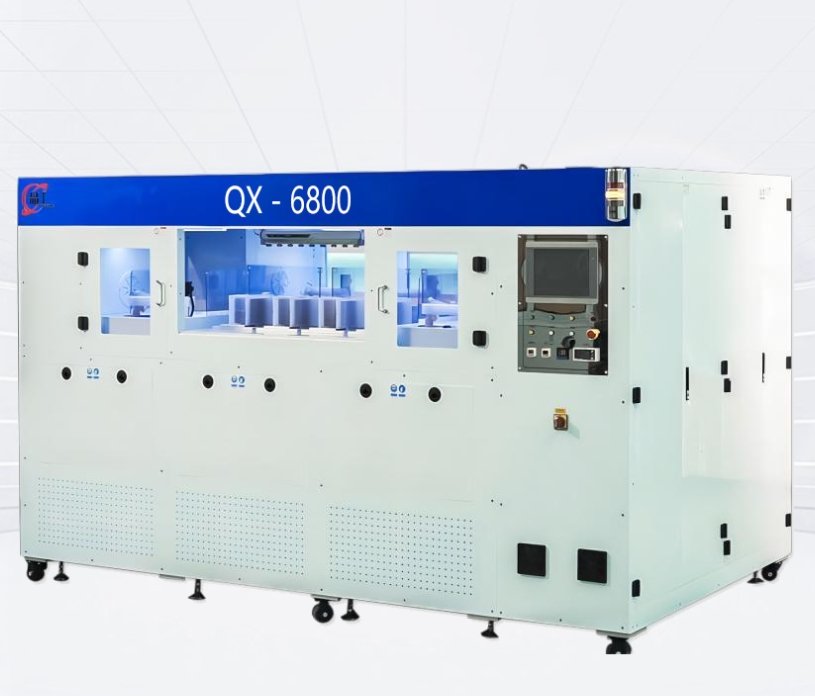
On the domestic supply of wet cleaning equipment, Hebei Zhongke Microelectronics Co., Ltd. designs its fully automatic single-wafer cleaning machine and single-wafer cleaning & spin dryer to be easily integrated with UPW, wet electronic chemicals and waste-liquid systems, with user-friendly piping, valves and chamber design. It also offers wafer spin dryers (6/8 inch and 12 inch) as whole-line supporting products, helping customers reduce equipment-to-facility integration cost.
Waste-liquid and chemical recovery is the other half of the story. Spent sulfuric acid, hydrofluoric acid and rinse water cannot simply be discharged; fabs neutralize, recycle and treat them to meet environmental regulations, and increasingly to recover value from concentrated chemistry. A cleaning tool that consumes excess water or chemistry raises both operating cost and the burden on the waste system, which is why modern single-wafer tools are designed to minimize chemical and rinse-water volume while maintaining cleaning performance. The interplay between cleaner efficiency and facility recovery is thus a key lever in total cost of ownership, and it rewards vendors who understand both the process and the utility side.
The economic dimension is easy to overlook. UPW plants and chemical delivery systems consume a large share of a fab's utility budget, and any reduction in rinse water or chemical volume directly lowers operating cost. Modern single-wafer tools are designed to use far less chemistry per wafer than legacy batch benches, partly through precise metering and partly by optimizing rinse sequences. As fabs balance capacity growth against energy and water consumption, cleaning tools that document their utility usage become an attractive investment, because the savings compound over many years of production.
For wafer fabs, stable water and chemical supply is as important as advanced cleaning equipment, and together they form the yield foundation of every cleaning step. From ultra-pure water to wet electronic chemicals, the 'water' system behind cleaning is the hidden foundation of yield. To learn about cleaning equipment and UPW/chemical system matching, call the consultation hotline: 17177768881.