
As demand for indium phosphide and gallium arsenide substrates continues to grow, vertical gradient freeze (VGF) crystal growth furnaces have evolved from early laboratory equipment into mainstream production tools for compound semiconductor crystal growth. Several domestic equipment makers have launched larger, higher-stability VGF systems, and the penetration of domestic furnaces into InP and GaAs lines is rising rapidly.
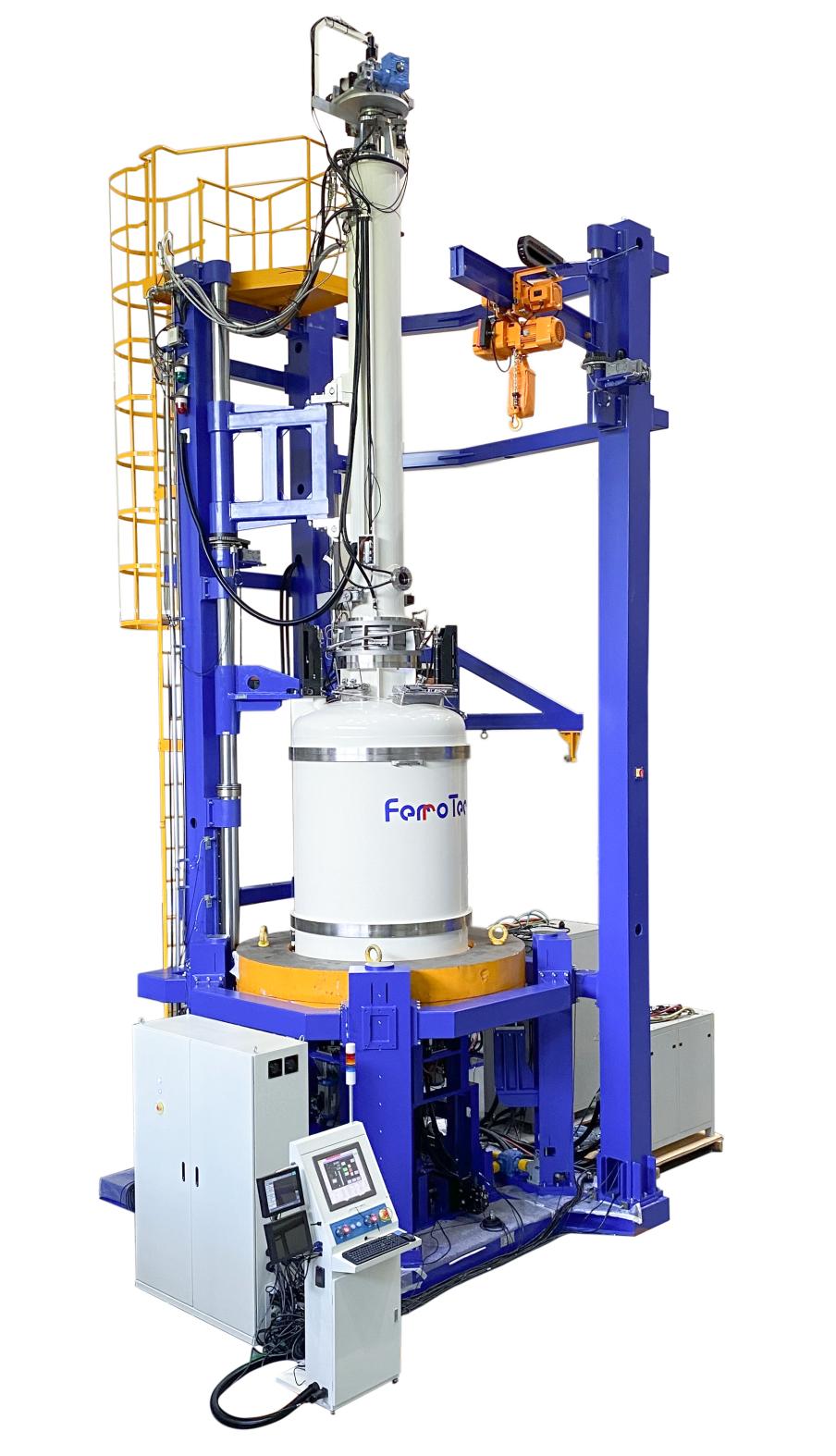
Why VGF Became the Production Favorite
VGF establishes a gentle axial temperature gradient inside a sealed ampoule so that the melt solidifies directionally from the seed end, yielding low-dislocation, large-diameter boules. Compared with Czochralski, VGF crystals do not rotate or pull, so thermal stress and dislocation density are lower. Compared with horizontal Bridgman, VGF produces cylindrical boules that improve wafer slicing utilization. For InP, where phosphorus vapor pressure is extremely high at growth temperature and composition easily drifts, the sealed ampoule structure effectively suppresses evaporation and delivers clear yield advantages, making it ideal for mass production.
Progress of Domestic Furnaces
In recent years, domestic VGF furnaces have advanced steadily in thermal field simulation, multi-zone temperature control, vacuum and ampoule handling, and automated crystal extraction. They can now stably grow 4-inch InP and 6-inch GaAs boules. Some domestic suppliers also offer integrated lines spanning growth furnaces and back-end processing, helping substrate makers shorten ramp-up from installation to mass production and reduce dependence on imported equipment. Localized after-sales service and readily available spare parts have become important factors favoring domestic furnaces.
Downstream Demand Drives Equipment Volume
RF chips, photonic devices, LEDs, and power devices all consume InP and GaAs substrates, and AI data center optical modules in particular have sharply pulled InP substrate demand. Substrate makers are expanding capacity and building new crystal lines to match orders, driving concentrated purchases of VGF furnaces. With their cost performance and responsive service, domestic equipment has captured a strong share of this expansion wave.
Technical Specs of Modern VGF Furnaces
A production VGF system comprises a sealed quartz ampoule containing the polycrystalline charge and seed, a multi-zone resistance or rf furnace, a temperature-control stack with closed-loop zoning, and a mechanism to move either the ampoule or the heater array at a precisely controlled rate. Modern domestic systems can hold axial temperature gradients within a narrow band, automate ampoule loading and extraction, and log growth parameters for traceability. These capabilities matter because small variations in gradient or translation rate can change dislocation density, boule diameter, and even crystal polytype. The ability to reproduce a validated run across many furnaces is what allows a substrate maker to scale output without sacrificing consistency.
Competitive Landscape for Growth Equipment
For years, high-end compound crystal growth equipment was dominated by a handful of European and Japanese suppliers, with long delivery schedules and premium pricing. Domestic entrants have now reached the point where their furnaces match key specifications for 4-inch InP and 6-inch GaAs growth, while offering faster delivery, local spares, and on-site process support. This shift is reshaping buyer behavior: new substrate projects increasingly evaluate domestic furnaces on equal footing, and some capacity expansions are built entirely around domestic equipment. The result is a virtuous cycle in which more installed bases generate more process data, which in turn improves the next generation of furnaces.
Outlook for VGF Furnace Demand
Looking ahead, the VGF furnace market will keep expanding as InP and GaAs substrate capacity grows. Domestic equipment, with its cost performance and local service, is expected to gradually replace imports in the mid- to high-end segment. For substrate makers, furnace stability, energy consumption, and maintenance cost directly affect profitability, and choosing a domestic equipment partner with a proven line record is critical. At the same time, integrated supply of growth furnaces together with back-end cleaning and inspection equipment is becoming a new competitive frontier, and suppliers that can deliver full-line solutions hold an advantage as the industry matures. For new substrate projects, the decision increasingly weighs total cost of ownership over furnace lifetime, including yield, consumable burn rate, and the responsiveness of the equipment supplier. Domestic VGF makers that have accumulated installed base are now turning that field experience into better process recipes, which further widens the gap with generic imported equipment and accelerates the transition to localized supply. As more fabs qualify domestic VGF furnaces, the feedback loop between field experience and equipment improvement tightens, making it increasingly realistic for new substrate projects to specify domestic equipment from day one rather than as a later upgrade. This shift lowers the barrier for new entrants and accelerates the overall pace of domestic compound substrate expansion.
From Furnace to Wafer: The Full Flow
A VGF furnace is only the first step in producing a usable substrate. After the boule is extracted, it must be ground to diameter, orientation flat applied, sliced with a multi-wire saw, lapped, etched to remove subsurface damage, chemo-mechanically polished to a mirror finish, and then carefully cleaned and spin-dried before shipping. Each of these steps introduces its own yield risks, and a defect in any one of them can waste the value already built into the crystal. This is why substrate fabs increasingly look for equipment suppliers who can coordinate growth furnaces with back-end processing, rather than buying isolated tools. Integrated supply reduces integration risk, shortens ramp-up, and makes process debugging faster when problems arise, which is a major benefit for new capacity projects.
Integrated Back-End Coordination
After the boule comes out of the furnace, it still requires wire sawing, grinding, polishing, cleaning, spin drying, and visual inspection. Hebei Zhongke Microelectronics Co., Ltd., based in Fuxing District, Handan, has long focused on localizing compound semiconductor equipment. Its VGF crystal growth furnace serves InP and GaAs growth, while its wafer unloading table, fully automatic single-wafer cleaning machine, InP cleaning machine (SQX-150-5Y1D), wafer spin dryer (6/8 inch), and wafer inspection lamps (QG-150/QG-250) form a coordinated capability from crystal growth through wafer back-end processing, helping substrate makers build a fully localized line.
Domestic VGF furnaces provide the equipment foundation for compound substrate expansion. To learn about VGF crystal growth furnaces and wafer unloading, cleaning, and drying solutions, call the consultation hotline: 17177768881.