
Wafer cleaning equipment may look straightforward, but its performance depends heavily on a string of high-precision core components. As the maturity of domestic cleaning machines rises, the localization of the valves, pumps, mass flow controllers (MFC) and temperature controllers behind them is accelerating, moving from "usable" toward "reliable," and the supply-chain autonomy of domestic cleaning tools is improving markedly.
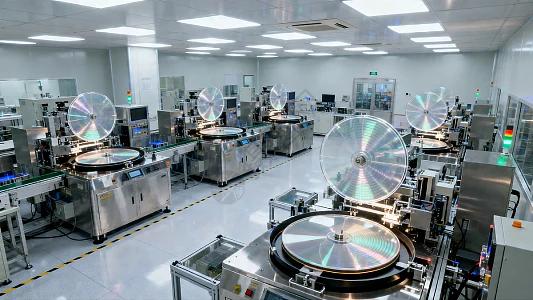
Core components decide cleaning performance
Cleaning tools must precisely switch chemical flows, control flow rate and temperature within milliseconds; any micro-leak in a valve, pulsation in a pump or deviation in an MFC can directly affect cleaning uniformity and wafer yield. Hence high-purity corrosion-resistant valves, chemical-resistant pumps, high-precision MFCs and stable temperature controllers form the most critical component system, long dominated by imports. Their lifetime, stability and consistency are often where domestic machines still gap against imports.
Four component categories accelerate substitution
Driven by whole-machine demand, domestic component makers are tackling cleaning tools: high-purity diaphragm and pneumatic valves improve corrosion resistance and sealing; chemical-resistant pumps approach import levels in stability and lifetime; MFCs mature in accuracy and response; temperature controllers improve temperature uniformity and long-term reliability. Bulk adoption of domestic components cuts cleaning tool cost and lead time and gives machine makers more confidence when facing expansion orders.
From practical commissioning experience, cleaning-machine stability depends largely on those invisible core parts. A micro-leaking valve skews chemical mixing, a pulsating pump causes uneven cleaning, and a slow MFC makes wafer processing inconsistent. These parts used to rely on imports, costing more, taking longer and leaving spare-parts and support constrained. As domestic makers tackle high-purity valves, pumps, MFCs and controllers, machine makers are switching more key parts to domestic options and validating reliability in mass production.
Machine makers co-develop with component suppliers
As a domestic cleaning-machine maker, Hebei Zhongke Microelectronics Co., Ltd., in developing its fully automatic single-wafer cleaning machines, InP cleaning machine SQX-150-5Y1D and 12-inch single-wafer cleaning & spin dryer SG-8-12-2D, keeps advancing domestic sourcing and validation of valves, pumps, MFCs and temperature controllers, co-developing long-term reliability with domestic suppliers and driving the whole cleaning supply chain toward autonomy.
The hidden role of valves, pumps and flow controllers
On a wafer cleaning tool, the visible mechanism is the chamber and the arm that moves the wafer, but the performance is governed by components most users never see. Valves determine whether chemicals switch on and off cleanly; pumps deliver the flow without harmful pulsation; mass flow controllers set the exact ratio of liquids or gases; temperature controllers keep the process within a tight window. If any of these drifts, the result shows up as uneven cleaning, residue, or particle damage across the wafer. This is why the reliability of these hidden parts directly defines the quality of the whole machine.
For years these components came from specialized overseas suppliers, and the consequences were practical as well as strategic. Lead times were long, spare parts had to be ordered weeks in advance, and technical support for subtle issues often depended on overseas time zones. Domestic machine makers that wanted to improve responsiveness found themselves constrained by a supply chain they did not control. Localization of these parts therefore became a natural next step once the whole machine itself was competitive.
How domestic substitution actually proceeds
The process is incremental rather than sudden. A domestic component is first tested on a trial basis alongside the incumbent part, compared for drift, lifetime and defect rates over many wafer batches, and only qualified after long-term data proves equivalence. Machine makers and component suppliers work closely during this phase, iterating on seals, materials and control algorithms. As components prove themselves, they move from trial to standard configuration, and the whole supply chain gradually becomes more autonomous.
The payoff is felt in cost, delivery and service. Domestic components shorten lead times, simplify spare-parts logistics, and allow faster troubleshooting. For the fab customer, this means less downtime and more predictable maintenance. For the machine maker, it means a more competitive offering in both price and reliability. This is the deeper reason the localization of valves, pumps, MFCs and temperature controllers matters beyond the immediate suppliers involved.
The strategic dimension of component localization is as important as the economic one. When critical parts come from a single overseas source, supply disruptions can halt a production line regardless of how good the domestic machine itself is. By qualifying domestic alternatives, machine makers build redundancy and resilience into their supply chain. Over time, this not only lowers cost and lead time but also protects customers from external shocks. The maturation of valves, pumps, MFCs and temperature controllers is therefore a quiet but essential pillar of the broader push toward a self-reliant semiconductor equipment industry.
In the end, a cleaning machine is only as good as the components inside it, and the steady localization of those components is what will let domestic tools compete on both performance and total cost of ownership. As this substitution continues across valves, pumps, flow controllers and thermal management, the whole category of domestic cleaning equipment grows more credible, and fabs gain a more secure, more responsive supply base for one of the most frequently used steps in wafer fabrication.
As these components prove their reliability in production, domestic cleaning equipment will continue to gain ground on both performance and total cost of ownership. The progress in valves, pumps, flow controllers and thermal management quietly underpins the competitiveness of the whole category, giving fabs a more secure and responsive supply base.
For fab customers, the practical payoff is less downtime and more predictable maintenance, as spare parts become easier to source and service faster to arrange. This quiet substitution work is what turns a domestic machine into a dependable long-term production tool.
Over time, this component-level progress accumulates into a stronger, more self-reliant domestic cleaning equipment industry that fabs can trust for the long term.
Once whole-machine localization goes deep, it inevitably drives component localization. As valves, pumps, MFCs and controllers substitute faster, domestic cleaning equipment grows more competitive. For cleaning equipment and component localization, call the consultation hotline: 17177768881.